Showing posts with label Informational. Show all posts

Sunday, May 15, 2011

Eyewitness Books: Civil War

Bibliographic information: 
Stanchack, John.  Eyewitness Books: Civil War.   London: Dorling Kindersley, 2000.

Brief plot description:
The Civil War is broken down into what happened before, during, and after the war.  The book includes the election of 1860, the Underground Railroad, the role of women, the commanders and soldiers in the war, several of the battles, who surrenders, the role of the top leaders, and much more.  On every page there are pictures with captions that allow the reader to both visualize and understand the events in the book.  Besides the pictures, there is a paragraph giving more information about the subject and is used as an introduction to the pictures.  This book contains much information.  For example, women would disguise themselves as men to join in the fighting or how they would help care for the sick.  Moreover, the book discusses the age of the men fighting including the old and the really young.

Brief review:
I would use this book as supplemental material in a fifth through ninth grade class.  The Civil War is an important part of the history of America and should be looked at in more depth.  I feel that this book would be a great tool for doing that.  The amount of information allows the reader to stay hooked because the information is presented in a friendly and easy way to comprehend.  The style of the book really helps students find the information needed and understand the information.  The photographs in the book will help students understand what is being described in the text. 

Genre label:
Informational History

Reading level/interest level:
5th-9th grade

Similar materials in style content, theme or characters:
Eyewitness Books: World War II by Simon Adams
Eyewitness Books: American Revolution by Stuart Murray
Visual Dictionary of the Civil War by John Stanchak

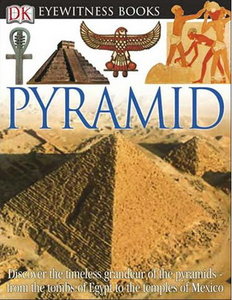
Eyewitness Books: Pyramid

Bibliographic information: 
Putnam, James.  Eyewitness Books: Pyramid.  London: Dorling Kindersley, 2003.

Brief plot description:
This book is all about different pyramids throughout the world.  The book contains a table of contents page and an index.  Some of the things that this book talks about are what and why a pyramid is built, the pyramids at Giza, the Great pyramid, the Sphinx, the pyramids the Aztecs and Mayans built, and many more.  In this book there are many pictures and captions that describe what is being discussed.  This means that there is not much text book style reading to do.  With the pictures students can look inside a pyramid, look at the old writings found on a pyramid, look at the tools that were used to build them, and many other things. 

Brief review:
I would use this book in a fifth through eighth grades; it might be able to be used even in the higher grades.  This book contains much information and would be a great resource for students to use when discussing pyramids.  This book would serve as supplemental material for a pyramid unit or a unit on Egypt.  The information in this book could be expanded into talking about the different cultures that build pyramids.  The style of the book really helps students find the information needed and understanding the information.  The photographs in the book will help students understand what is being described in the text. 

Genre label:
Informational

Reading level/interest level:
5th-8th grade

Similar materials in style content, theme or characters:
Eyewitness Books:  Castle by Christopher Gravett
Eyewitness Books:  Mummy by Peter Chrisp
Ancient China by Arthur Cotterell

Fats, Sugars, and empty Calories: the Fast Food Habit

Bibliographic information: 
Libal, Autumn.  Fats, Sugars, and empty Calories: the Fast Food Habit.  Philadelphia : Mason Crest Publishers, 2006.

Brief plot description:
This non-fiction book is part of a series written for adolescents called Obesity : Modern-Day Epidemic.  The books in the series are presented with colorful illustrations, lots of informational insets in colored boxes and current information about obesity.  In this book, Fast Food Habit the author discusses fast food from its beginnings in history to the present day.  She talks about the growth of McDonald’s and the food that they serve.  One chapter is devoted to the caloric count of fast foods.  Another chapter talks about how to get variety in your diet and the foods that the body needs.  Supersizing and food portions are the topic of one chapter.  Advertising and profit of fast food companies is discussed in another chapter. 

Brief review:
I would use this for fifth through eighth grade and even high school students.  The book does a good job of presenting factual information in an appealing and well-organized layout.  The book is well organized with a table of contents, glossary, further reading, for more information, index and biographies.  The writing style is direct but not preachy.  I would use this book when students are writing reports on the topics.  Other topics in the series include exercise, diets, social discrimination, emotions and body image.  This is current information about a topic that has been in the news and is written in a manner that students can understand.     

Genre label:
Informational

Reading level/interest level:
5th-8th grade, high school also

Similar materials in style content, theme or characters:
Want Fries with That?:  Obesity and the Supersizing of America by Scott Ingram
Eating the Plates: A Pilgrim Book of Food and Manners by Lucille Recht Penner

American Heroes

Bibliographic information: 
Delano, Marfe Ferguson.  American Heroes.  National Geographic, 2005. 

Brief plot description:
This book discusses the heroes of America.  The book is divided up into chapters that reflect certain years.  The chapter time periods are beginning to 1763, 1763-1789, 1789-1848, 1848-1877, 1876-1900, 1900-1941, and 1947-present.  The first thing that the book does is explain what an American hero is.  For each hero there is a fact box that includes their birth date, death, family members, honors, landmarks, milestones, other names, and other facts.  Next to the fact box is a couple paragraphs on the hero.  Some of the heroes in this book include Pocahontas, Ben Franklin, Lewis and Clark, Sojourner Truth, Abraham Lincoln, Chief Joseph, the Wright Brothers, Amelia Earhart, Franklin Roosevelt, Albert Einstein, Rosa Parks, and many more. 

Brief review:
I think that this book could be used in a fourth through eighth grade setting.  It would be a great book to use for research.  The lower grades could use this as an on level source, and the higher grades could use it as one of their many sources.  This book has great pictures and details about each hero.  Some of the pictures are not appropriate for some ages so you should look at them closely and talk about them before letting the students see them.  I think that this is a great book to use in a classroom when talking about different time periods in history. 

Genre label:
Informational

Reading level/interest level:
4th- 8th grade; maybe high school

Similar materials in style content, theme or characters:
An American Hero: The True Story of Charles A. Lindbergh by Barry Denenberg
All Shook Up: The Life and Death of Elvis Presley by Barry Denenberg
One More River to Cross: The Stories of Twelve Black Americans by Jim Haskins
Abe Lincoln Goes to Washington by Cheryl Harness 

Changing the Future for Endangered Wildlife: Tiger Rescue

Bibliographic information: 
Bortolotti, Dan.  Changing the Future for Endangered Wildlife:  Tiger Rescue

Brief plot description:
This book concentrates on an animal on the endangered species list.  The animal is the tiger.  This book contains a content page, an index, and an author’s note.  The book is broken into sections that talk about the problems facing tigers.  Some of these include information about the tiger such as where they live.  It also goes over some firsthand accounts of people trying to solve this problem.  These accounts come for China, Malaysia, and other conservations.  The author discusses how the tiger hunts and how it is being hunted and why.  At the end of the book is information about how to help save tigers.  This information contains the names of organizations, their web and street addresses, phone numbers, and information on what they do.  The book contains many pictures that help bring to the reader the cause. 

Brief review:
This book will give the students the opportunity to read about a problem in our world. As the students read the book they will problem-solve several words and will be asked if they can come up with a solution to why the tiger is endangered.  Some of the words that they may have difficulty with are prognosis, rehabilitate, controversial, umpteen, retaliation, amenities, and ringgit.  The story also provides opportunity to use strategies on extended text.  This text has captions and boxed information that will need to be read for understanding. After reading the text the students will have a better understanding of informational books because of the format, and the reader might be able to make a connection with this book if they have a pet. Students will be given an introduction on this book because of the informational format, and because there are concepts that will need to be explained.

Genre label:
Informational, Animals

Reading level/interest level:
 4th - 6th 

Similar materials in style content, theme or characters:
Dinosaurs to Dodos: An Encyclopedia of Extinct Animals by Don Lessem
Turtles by Anita Baskin-Salzberg , Allen Salzberg

Magic Tree House Research Guide: Dolphins and Sharks

Bibliographic information: 
Osborne, Mary Pope, Boyce, Natalie Pope.  Magic Tree House Research Guide: Dolphins and Sharks.  A Stepping Stone Book, 2003, illust. Murdocca, Sal, p. 128.

Brief plot description:
Have you ever been on a trip to see something and then when you got back want to learn more about the things seen?  In this book Jack and Annie have gotten back from a trip and decided to learn more about dolphins and sharks.  The first chapter the reader learns about the size of the ocean, the layers of the ocean, the food chain, and the coral reef.  In the next two chapters the reader learns about dolphins; specifically their characteristics, types, and communication.  Then there is information about sharks including the types of sharks, predators, and hunting abilities.  Dolphins and sharks are in danger from being caught by fishing nets and ships messing up their echolocation.  Scientists are doing research on how to protect the dolphins and sharks, and conservationists are also helping protect dolphins and sharks.  The book ends with some things that one can do to help protect these animals in the wild. 

Brief review:
I like this book because it gives great information on dolphins and sharks in a chapter book.  This book could be used in fourth through sixth grade as a research book or individual read.  I think that the book could be used as supplemental text or when talking about the ocean and the animals that live in it.  I think that children will enjoy this book because it is part of a popular series and because the information is really interesting.  The book provides more research guides that can be helpful, such as, videos and the internet.  The book also has a table of contents and index.  On the pages are illustrations that are black and white and look like sketches.  There are also extra information or definitions of words mentioned in the text.  Some of the illustrations are real photos that have been printed in black and white. 

Genre label:
Informational, Animals

Reading level/interest level:
4th – 6th graders

Similar materials in style content, theme or characters:
Magic Tree House Research Guide: Pirate by Will Osborne
Magic Tree House Research Guide: Rain Forests by Will Osborne
Dolphins at Daybreak (Magic Tree House, Book #9) by Mary Pope Osborne