Showing posts with label Poetry. Show all posts

Sunday, May 15, 2011

Extra Innings: Baseball Poems

Bibliographic information:
Selected by Hopkins, Lee Bennett.  Extra Innings: Baseball Poems.  Harcourt Brace Jovanovich, 1993, illust.  Medlock, Scott, p. 40.

Brief plot description:
The poems specifically describe outfield players, the Mets, Little League teams, pitching, girls playing ball, catching, Casey, Jackie Robinson, types of pitches, umpires, perfect games, stealing bases, and Joe DiMaggio.  Most of the poems have a normal form while others are not aligned straight.  The poem about Casey was the only poem that required more than one page.  The poem “Overdog” has rhyming in which the first and second lines rhyme in most of the stanzas.  The font is not always the same in each poem, and the poem is on one page with the illustrations on the opposite page.  The illustrations are either in black and white or in color.  Most of them are not finely detailed, while some of them look like paintings.  Some of the illustrations that go with the poems about real life players look like they were based off photographs.

Brief review:
I liked Extra Innings: Baseball Poems because it shows a variety of poems about baseball.    It also is good because it can be used in grades fourth through seventh.  I think the younger grades would enjoy this book as a read aloud while the older tweens would enjoy reading it on an individual bases.  The content in these poems may help some reluctant readers enjoy poetry through sports.  It also illustrates the different kinds of poetry that can be written.  There was one hard word, plaudits that may not be understood by some tweens.  This book of poems includes a contents page and a permission acknowledgement page. 

Genre label:
Poetry

Reading level/interest level:
4th-7th grade

Similar materials in style content, theme or characters:
Casey at the Bat: A Ballad of the Republic Sung in the Year 1888 by Ernest L. Thayer
A Child’s Anthology of Poetry by Elizabeth Hauge Sword

he Earth Under Sky Bear’s Feet: Native American Poems of the Land

Bibliographic information: 
Bruchas, Joseph.  The Earth Under Sky Bear’s Feet: Native American Poems of the Land.  Trumpet, 1995, illust. Locker, Thomas, p. 30.

Brief plot description:
The topics that these poems are about are stars of the bear, following Sky Bear, fireflies, flute to help things grow, Northern lights, mice, releasing the stars into the sky, seven wise men that become stars for all to see, how good rains come, roaming Earth, lots of song references, and dancing.  These poems are written by many Native American tribes located across the United States.  The illustrations help tell the story of the poem, are in color, some bright colors others dull, detailed but not finely detailed, and they match the poems.  The extras in the book Author’s Notes and A Note About this Book.

Brief review:
I like this book because it tells several interesting poems about Native Americans and how they live or what they commonly think of Earth.  I think this book would be good for fourth graders through sixth grade as a read aloud and individual read.  This book would be great to use when discussing the many tribes of Native Americans.  The illustrator included pictures that were brilliant and helped tell the different stories.  It could also be used to talk about poems and the type of poems and how they can be used to tell stories. 

Genre label:
Poetry

Reading level/interest level:
4th – 6th grade

Similar materials in style content, theme or characters:
The Girl Who Married the Moon: Tales from Native North American by Joseph Brunchac
Tikta-Liktak: An Inuit-Eskimo Legend by James M. Houston
How Many Spots Does a Leopard Have?: And Other Tales by Julius Lester

Casey at the Bat: A Ballad of the Republic Sung in the Year 1888

Bibliographic information:
Thayer, Ernest L.  Casey at the Bat: A Ballad of the Republic Sung in the Year 1888.  Simon & Schuster Books for Young Readers, 2003, illust. Payne, C.F., p. 32. 

Brief plot description:
The first and second lines of the poem rhyme and the third and fourth line of the poem rhyme.  This rhyming is the same throughout the thirteen stanzas.  The poem is about the Mudville baseball team who is in the last inning with two outs.  The two team mates before Casey made it to base, and now the team is counting on Casey to hit a homerun.  The crowd goes wild with Casey as the last at bat.  The pitcher isn’t playing fair and the audience and Casey are mad at the pitcher.  Casey strikes out and the Mudville team loses.  The book includes A Notes About the Poem.  The illustrations are colorful, bright, and detailed.  Each stanza has an illustration and each stanza is on one page.  The poem flows very smoothly and is very descriptive.

Brief review:
I like this poem because it tells a classical story about Casey at the Bat.  I really liked it because it flowed well and had great illustrations.  This book could be read by fourth through sixth grade tweens.  It would be a good book to use as a read aloud or individual read.  This book could be used for people who do not like poems but love baseball or sports.  I feel that this book will help students enjoy poetry.  There are some unfamiliar words that might cause some problems though so a student should either have a dictionary or there should be a class discussion on new words.

Genre label:
Poetry

Reading level/interest level:
4th- 6th grade

Similar materials in style content, theme or characters:
Honus & Me (Baseball Card Adventure) by Dan Gutman
A Light in the Attic by Shel Silverstein

Saturday, May 14, 2011

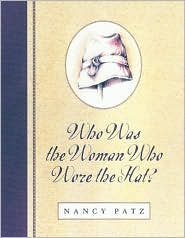
Who Was the Woman Who Wore the Hat?

Bibliographic information: 
Patz, Nancy.  Who Was the Woman Who Wore the Hat?  Dutton Books, 2003, p. 38.

Brief plot description:
This is a prose poem that tells of a hat seen in a Jewish Museum.  The woman telling the story wanders what was the woman like that wore the hat.  The woman could have lived in Amsterdam; it could have been the woman telling the story hat, or someone else that she knew.  She finds it is sad to think about, but also important to know about what happened to the Jews.  The illustrations are sketched; color, some real pictures with additional sketches around them, and the colors of the pages represent death or darkness.  The book includes author’s note and chronology of the Holocaust.

Brief review:
I like Who Was the Woman Who Wore the Hat? because it tells a story of a hat that belonged to a Jewish woman who lived during the time of the Holocaust.  I think the main idea of this book is that it could have been a relative’s hat.  This idea might be something that students can relate to because their family could have an item from a relative that has significant importance to their family.  I think the book could be used for fourth through sixth grade as a read aloud or individual read.  The book could be used when discussing the Holocaust or poems. 

Genre label:
Poetry

Reading level/interest level:
4th- 6th grade

Similar materials in style content, theme or characters:
The Stone Lamp: Eight Stories of Hanukkah Through History by Karen Hesse
Witness by Karen Hesse

Awards:
2003 Sydney Taylor Award
Parent’s Choice Recommended 2003
CBC-Notable Social Studies Trade Books for Young Readers 2004

Brown Angels An Album of Pictures and Verse

Bibliographic information:
Myers, Walter Dean.  Brown Angels An Album of Pictures and Verse.  HarperCollins Publishers, 1993, p. 36.

Brief plot description:
The author begins by telling the reader where he got the pictures.  Each of the poems is either written about the picture, by children he knew, or by the day.  The poems that are in the book are “Friendship”, “Blossoms”, “Love That Boy”, “Zudie O, Zuide O”, “Prayer”, “They”, “Jolly, Jolly”, “Summer”, “Pretty Little Black Girl”, “Jeannie Had a Giggle”, and “Pride.”  Each poem rhymes in some way and some of them use the element of imagery.  The illustrations in this book are all photographs that show African American children.  The photographs and imagery bring this book to life.  For example, “Pretty Little Black Girl” describes four girls that are different skin color and do different things, or in “Jeannie Had a Giggle” the picture shows a girl that is all smiles. 

Brief review:
I really enjoyed these poems and photographs.  The photographs bring the poems to life and are just interesting to look at.  I think that this book could be used in fourth through sixth grade.  It could be used as a read aloud for the really early grades and an individual read for the older students.  The poems could be used during Black History month, when discussing emotions of children, or when discussing children in general.   It could also be used when teaching a poetry unit as examples of different types of  poetry and how illustrations and poems  can be tied together.  

Genre label:
Poetry

Reading level/interest level:
4th – 6th grade

Similar materials in style content, theme or characters:
Lives: Poems about Famous Americans by Lee Bennett Hopkins and Leslie Staub
Words with Wings: A Treasury of African-American Poetry and Art by Belinda Rochelle
Honey, I Love: And Other Love Poems by Eloise Greenfield

Awards:
Notable Children’s Books of 1994 (ALA)
1994 Notable Trade Books in the Language Arts (NCTE)
1994 Books for the Teen Age (NY Public Library)
Children’s Books of 1993 (Library of Congress)